What happens when a young man has to run away from love in his quest for agency and self-worth?
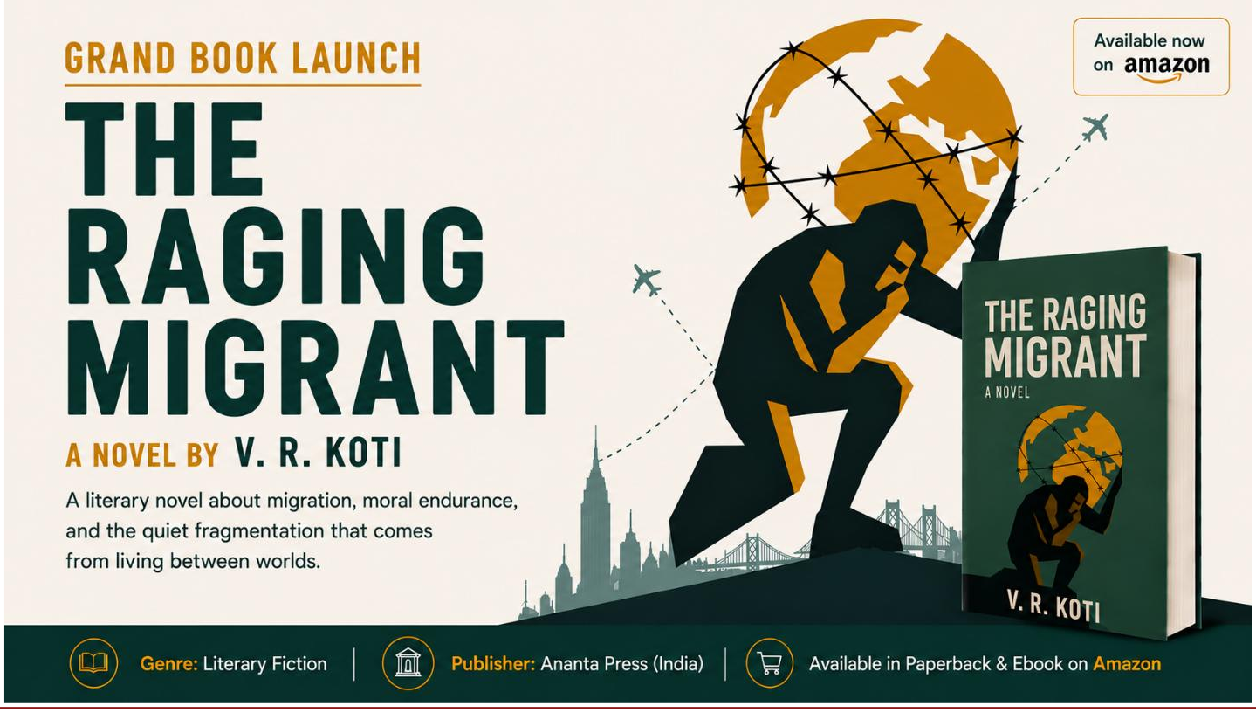
That is the question at the heart of The Raging Migrant, the debut novel by V. R. Koti. This is not a book that offers easy answers or convenient resolutions. Instead, it asks the kinds of questions that linger long after the final page has been turned.
Far from being a feel-good story about chasing the American Dream, The Raging Migrant is a deeply human exploration of migration, identity, family, masculinity, and belonging. It examines what migration truly costs, what silence does to the human spirit, and what it means to remain compassionate in a world that often rewards hardness and punishes vulnerability.
What is ‘The Raging Migrant’ about?
At the centre of the novel is Krishna Kant Sharma, known as KK, a young Indian man whose home life is shaped by debt, alcohol, family tensions, and unspoken disappointments.
His father drinks. His mother struggles to keep the family together. A loan of ₹12.5 lakh looms over the household. Fresh out of college, KK finds himself trapped between obligation and aspiration, wondering whether he should stay and confront the chaos around him or leave in search of a better future.
He chooses to leave. Convinced that education, distance, and a fresh start in the United States will provide the clarity and purpose missing from his life, KK embarks on a journey that promises opportunity. But America has its own barriers.
In the years following 9/11, KK encounters racial suspicion, social hostility, and the emotional isolation familiar to many immigrants. A brutal attack on a friend, a marriage strained by secrecy, and a series of moral dilemmas force him to confront a devastating question:
Was he running toward something meaningful, or merely running away? The result is a powerful novel about migration, moral courage, resilience, self-destruction, and the inherited burdens of family.
A Glimpse into the Novel's Themes
The novel opens with a sense of quiet unease.
KK's father disappears in the middle of the night. His mother searches for him. His grandmother delivers sharp observations from her bed. Then comes Aunt Lakshmi, adorned in silk and jewellery, demanding repayment of the family loan.
Within a few pages, KK's understanding of his family begins to unravel. What makes these scenes powerful is not dramatic excess but restraint. Koti writes with precision and emotional intelligence. He understands how a cheerful smile can conceal desperation, how a family secret can alter an entire life, and how dreams sometimes feel more real than reality itself.
Another striking feature of The Raging Migrant is its rejection of conventional heroic archetypes.
KK is thoughtful rather than dominant, empathetic rather than aggressive, and frequently unsure of himself. He experiences anxiety, guilt, tenderness, and self-doubt without the narrative treating those qualities as weakness.
His acts of courage often involve restraint rather than conquest: caring for injured friends, choosing compassion over revenge, questioning his own motivations, or acknowledging emotional vulnerability.
Even when violence intrudes into the story, it is portrayed less as spectacle than as consequence. Physical confrontations leave psychological scars, forcing KK to examine his impulses and the costs of acting without reflection.
The novel therefore becomes an exploration of what healthy masculinity might look like when measured by responsibility, emotional honesty, and moral accountability instead of dominance.
A Meticulously-structured Emotional Journey
The chapter titles in The Raging Migrant are more than structural markers. They function almost like philosophical prompts.
Onward or Away? introduces the central ambiguity of KK's choices. Is he pursuing growth or escaping discomfort?
Arrival Without Anchors captures the disorientation of reaching a new country without emotional certainty.
The Body Never Forgetssuggests that trauma survives intellectual understanding, resurfacing through anxiety, memory, physical injury, and involuntary habits.
Conditional Loveinterrogates relationships shaped by approval, expectations, and compromise. The Cost of Silence asks what happens when difficult truths remain unspoken for too long.
By the time readers reach Holding the Center, the title resonates as the culmination of KK's search for equilibrium between family, love, ambition, identity, and self-respect.
These chapter names underscore that the novel's true landscape is psychological rather than geographical.
Why ‘The Raging Migrant’ Matters Today
Millions of Indians have migrated abroad in search of better opportunities. Most stories about migration focus on success: achievement, sacrifice, prosperity, and upward mobility. But what about the emotional cost? What about loneliness, cultural dislocation, uncertainty, grief, and the quiet accumulation of pain that often goes unspoken?
The Raging Migrant fills that gap.
The novel also offers a striking portrait of Indian family life, exploring the complicated coexistence of love and dysfunction, duty and resentment, silence and survival. One of the most memorable scenes occurs in the opening chapter, where KK lies awake listening to his parents argue through walls that seem far too thin. It is a moment of remarkable emotional truth and one that many readers will recognise instantly.
Beyond its Indian context, the novel speaks to anyone who has ever struggled with identity, expectation, or belonging. It is a story about what happens when you realise that home is no longer a place but a question.
Why Readers are finding ‘The Raging Migrant’ Relatable
In a publishing landscape crowded with stories that either glorify overseas success or reduce migration to statistics, The Raging Migrant offers something rarer: emotional precision.
It is a novel that recognises visas can be approved while relationships fracture, careers can flourish while identities remain unsettled, and physical distance can amplify rather than diminish the influence of home.
Readers looking for a fast-paced immigration drama may instead discover a reflective literary work about agency, belonging, grief, resilience, and the courage to confront oneself.
According to Asha Seth, Founder - MissBookThief and the book's marketing strategist, that authenticity is what makes the novel stand out:
"What moved me most about The Raging Migrant is its honesty. It goes beyond the familiar success stories and explores the emotional realities of migration, family expectations, and identity with remarkable depth. This is the kind of novel that lingers long after the final page."A Novel Designed to Spark Conversation
For Vikrant Thakur, Founder & Publisher of Ananta Press, the book represents exactly the kind of story that contemporary readers who harbour the big American dream need.
"At Ananta Press, we seek stories that provoke reflection and meaningful conversation. The Raging Migrant does that. It speaks to a generation navigating through questions of belonging, ambition, and selfhood, while remaining deeply rooted in the emotional truths of family and human connection."
At a time when migration is often discussed through statistics and economic outcomes, ‘The Raging Migrant’ reminds us that every migration story is ultimately a human story.
Why You Should Read ‘The Raging Migrant’
Read this novel if:
- You have ever felt torn between staying and leaving.
- You have ever struggled to reconcile love and disappointment within a family.
- You are an immigrant, know an immigrant, or want to understand the emotional reality behind migration.
- You enjoy literary fiction that asks difficult questions rather than providing easy answers.
- You appreciate stories that stay with you long after you finish reading them.
At its core, The Raging Migrant is not about crossing borders. It is about crossing thresholds within oneself. KK's journey from India to America is only the visible storyline. The deeper narrative follows his attempt to reclaim agency without losing compassion, to pursue ambition without abandoning love, and to discover whether healing comes from changing circumstances or changing perspective.
For anyone who has ever wondered whether the life they are chasing is worth what it asks them to leave behind, The Raging Migrant offers a thoughtful, emotionally resonant answer: the longest migration is often the one from survival to self-understanding.
About the Author
V. R. Koti spent more than twenty years writing nonfiction before making his fiction debut with The Raging Migrant. His professional background in systems thinking and sustainability is evident throughout the novel. He examines not only individual choices but also the larger structures that shape them, whether those structures are families, immigration systems, cultural expectations, or social institutions.
Koti currently lives in Atlanta, Georgia, where he runs a green building consultancy and continues to write literary fiction.
Reflecting on the novel's core themes, Author Koti says:
"Migration changes your address, but it does not automatically change your wounds. The Raging Migrant is about the difficult journey of confronting what we carry within us, even when we travel thousands of miles away from home."
That insight sits at the heart of the book itself.
Where to Get Your Copy of The Raging Migrant
Released in India on 10 June 2025 by Ananta Press, ‘The Raging Migrant’ is available through major online and offline retailers across India. International readers can also order copies through leading online platforms.
Buy your copy now: