
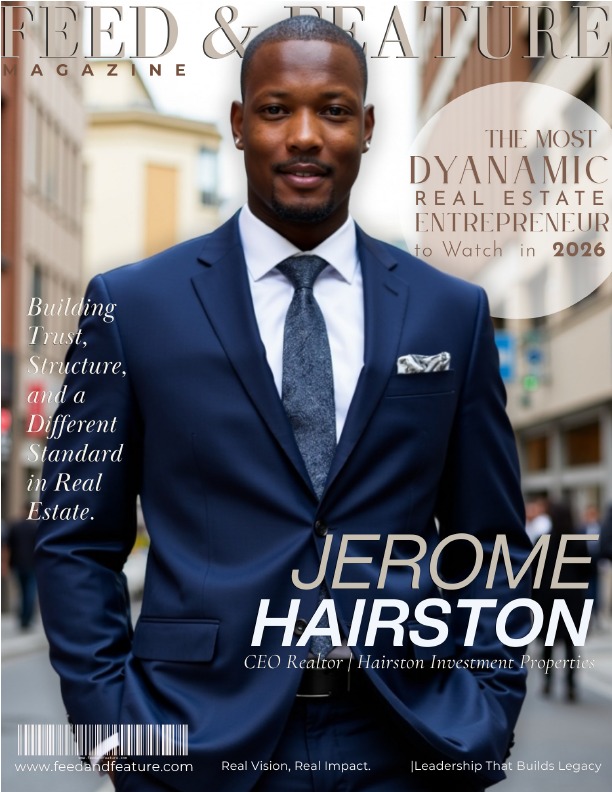
CEO, Realtor® | Hairston Investment Properties | Feed & Feature Magazine — The Most Dynamic Real Estate Entrepreneurs to Watch in 2026
Real estate is often discussed through numbers: price, square footage, rent, return, equity, cap rate, and cash flow. Those numbers matter. A deal that does not work on paper will not magically work because the story sounds good. But the deeper weight of real estate is carried by something less visible: people trying to make decisions about shelter, stability, family, money, risk, and their future. The transaction is always the visible part. The human being behind it is where the real stakes live.
That is where Jerome Hairston’s work begins. His approach is not transaction-first. It is relationship-first, structure-first, and outcome-first. Through Hairston Investment Properties, he is building a platform that connects real estate advisory, investment discipline, development thinking, and community impact. A home, an investment property, a development site, or a distressed asset may start as a piece of real estate, but the decision around it can change the direction of a family. He takes that very seriously.
His position is direct: real estate should not be reduced to chasing leads and closing volume. The work has to be built on trust, clarity, and disciplined execution. If the relationship is not aligned, the transaction is not worth forcing. If the numbers do not hold up, the project should not move forward. If the model cannot survive real-world pressure, it does not deserve to scale.
“I am not chasing deals. I am building something that can endure.”
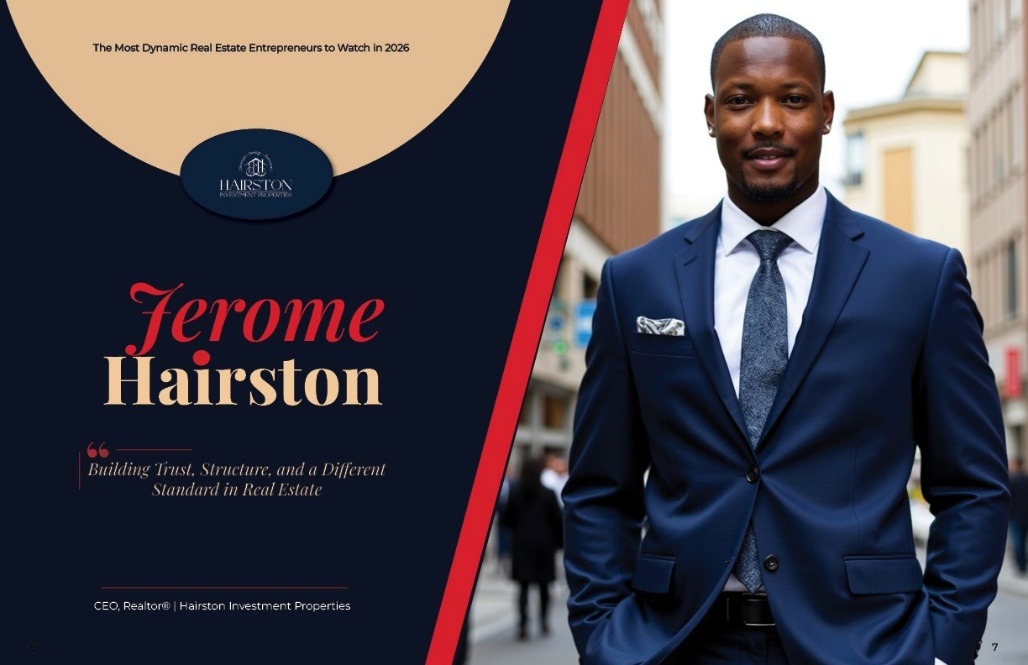
A Foundation Built Before Real Estate
Jerome’s entry into real estate was not driven by one sudden moment. It was the result of experiences that stacked over time: family, service, engineering, pressure, disappointment, and eventually clarity. At the personal level, one of the strongest early influences was his grandmother, Velma Jackson. She represented stability in a very concrete way. Her home, her garden, and the way she carried herself showed him that legacy is not an abstract concept. Legacy can be land. Legacy can be shelter. Legacy can be a home people return to long after it was built. Legacy can be a standard that outlives the person who created it.
That early understanding never left him. Later, reading Dean Graziosi’s work opened the door to a broader idea: real estate as a tool for strategy, freedom, wealth creation, and long-term positioning. Even before he pursued the industry seriously, the thought stayed with him. The interest did not fade. It waited until the rest of his life caught up.
His military and engineering background added the operational layer. In the Army, through engineering and project management, he learned to think in systems, constraints, logistics, site realities, sequence, risk, and execution under pressure. Many who know him will tell you he has always thought this way; the Army only strengthened that innate ability. Those habits now shape how he looks at properties, people, capital, and development. He does not look only at what something is. He asks what it can realistically become, and what must be true for that outcome to happen.
After corporate America did not open the next door, even after more than 1,500 job applications, He made the decision to move into real estate full-time. It was not because everything was easy or perfectly aligned. It was because waiting no longer made sense. He spent a full year creating his business plan. What he is building today is the convergence of those layers: his grandmother’s example, early real estate education, military engineering discipline, business strategy, and a desire to create something that is profitable without being empty.
“I did not move into this because everything aligned. I moved into it because waiting was no longer an option.”
Instability, Responsibility, and the Need to Build Differently
The work is also shaped by a clear memory of instability. Hairston does not speak about poverty or struggle as a branding device. He speaks about it because he understands what it means for a family to operate without enough margin. There were seasons in childhood where welfare was part of the family’s reality. Those experiences created an early understanding that security is not automatic. It has to be built, protected, and sustained.
The pandemic reinforced that lesson. Watching his family face loss, emotional strain, and financial pressure made the point unavoidable. Preparedness matters. Structure matters. Families cannot be left exposed because no one built the system before the crisis arrived. For him, that became more than a lesson. It became a personal standard that now shapes every layer of how he works.
That standard shows up in the questions he starts with: what structure helps people avoid being caught unprepared? What guidance makes a decision clearer? What model creates stability instead of dependency? He is not trying to build a company that only reacts to the next opportunity. He is trying to build systems that reduce uncertainty for clients, veterans, families, and eventually the communities his development work is meant to serve.
Legacy as Something People Can Stand On
Velma Jackson’s influence sits at the center of the larger vision. Jerome’s grandmother loved her garden until her final days. She chose to remain in the home she had built: the home she had made into a place of safety for her family. That home was not simply a residence. It was a physical expression of dignity, stability, independence, and belonging. Jerome lived there as a child. Her example stayed with him long after the family moved into a different chapter of life.
Because he does not have children of his own, legacy carries a different weight for him. It is not only about a direct biological line. It is about his family name, his nieces and nephews, his siblings, cousins, and future generations who may not fully understand the work today but may one day benefit from the structure being created. In that sense, legacy is not only what is remembered. It is what still works after the builder is gone.
“I am not trying to leave memories. I am trying to leave something people can stand on.”
That belief connects the real estate business, the planned Jackson Legacy Foundation, the family trust concept, and the broader development platform. They are not disconnected ideas. They are different functions within the same long-term architecture, each piece with a clear role, each designed to protect the others as the structure grows.
Hairston Investment Properties: A System, Not a Slogan
The core vision behind Hairston Investment Properties is not to build a real estate brand that survives on lead volume. The vision is to build a system that helps people make better decisions, create long-term wealth, and contribute to stronger communities. The company operates across real estate, investment, advisory, and development lanes, but the underlying purpose is clarity: helping people see options they did not know they had and make decisions with a clearer understanding of the consequences.
One encounter crystallized what that purpose looks like in practice. A veteran who works in law enforcement arrived to serve civil papers connected to a property-related legal matter. The interaction could have stayed tense and transactional. Instead, conversation opened another door. Hairston learned the man was unsure where to begin with his VA benefits and disability process. He shared what he knew and gave him direction. Months later, the veteran reported he had followed the guidance and received his VA rating. That outcome had nothing to do with a listing or a commission.
“Impact does not always arrive through a formal program. Sometimes it appears in an unplanned conversation when preparation meets the chance to help.”
Hairston Investment Properties is one part of a larger structure that includes the planned Jackson Legacy Foundation, with a long-term goal of creating housing, ownership pathways, and community stability. The business is the execution arm. The mission is broader. The long-term goal is to create systems that help families move from uncertainty into clarity, and from instability toward ownership and long-term stability.
The Compassionate Builder
Hairston uses the phrase compassionate builder carefully. It does not mean softness or passive concern. It means care backed by execution. Compassion, by itself, can remain a feeling. Building requires structure, discipline, capital, planning, and follow-through. The phrase only works when both parts stay attached, and he holds both with equal seriousness.
His background in military service informs that view. He believes people who choose the military, firefighting, and law enforcement often carry a deep level of compassion, even when they would not describe it that way. You do not stand in harm’s way for people you may never meet unless some part of you cares about something larger than yourself. But service also teaches that care must be organized into action. Intent alone changes nothing.
In real estate, being a compassionate builder means not treating people as transactions. It means considering their situation, pressure, goals, fears, and future, and then doing something useful with that understanding. Sometimes that means helping a veteran understand a benefit he earned. Sometimes it means advising a buyer to slow down instead of pushing them toward a close. Sometimes it means looking at a deteriorating neighborhood and asking what it could become if someone cared enough to build it correctly.
“Compassion without execution does not change anything.”
The builder side is what turns concern into housing, education, opportunity, and stability. Without structure, compassion can become performance. Without compassion, structure can become cold and disconnected from the people it is meant to serve. Hairston’s model is built in the space where the two meet: care with discipline, service with standards, and impact that can be measured in actual outcomes.
The Problem Is Instability
The central problem Jerome is addressing is instability: housing instability, financial instability, community deterioration, and the absence of clear pathways from survival into ownership. These problems are connected, but they are often treated as separate issues requiring separate solutions. He is trying to address them together.
Behind every real estate transaction is a person or family trying to navigate risk, affordability, timing, financing, and long-term consequences. A purchase is not only a purchase. An investment is not only a number on a spreadsheet. These decisions can change confidence, mobility, stability, and generational position. That is why the relationship matters. If there is no trust, the work does not hold. He is clear that not every situation should be pushed toward a transaction — the right alignment has to exist first.
At the community level, the same instability appears in a larger form. Some neighborhoods face deterioration, limited investment, restricted housing options, and weak pathways to ownership or economic mobility. Those conditions do not improve through activity alone. They require structure, capital, guidance, development discipline, and a long-term commitment to the people who live there.
“A single decision in real estate can change a family’s future. The problem is that too many people are forced to make that decision without the right guidance.”
Jackson Legacy Foundation: Planned Mission Layer
The Jackson Legacy Foundation is a planned framework intended to turn Velma Jackson’s legacy into a living system, not charity as performance, but a mission organized into structures that support housing stability, community resilience, and practical education. The name carries his grandmother’s legacy, but the intent is forward-looking. The foundation is meant to do real work, not simply honor memory.
Planned areas of impact include affordable housing support, community stabilization, skill-building, hydroponic and STEM-based education, financial literacy, and youth entrepreneurship. The deeper goal is self-sufficiency, not helping people in a single moment, but building environments where people can stand stronger over time. Jerome envisions a young person learning to grow food, understanding the science behind it, selling what they produce, and beginning to grasp how money, ownership, and responsibility connect.
The foundation is part of a deliberate governance structure. The foundation lane is intended to hold the mission and community alignment. Hairston Premier Ventures, doing business as Hairston Investment Properties, remains the execution and development arm. Project-specific LLCs can hold individual assets and isolate risk by deal. This separation is not paperwork for its own sake. It is how the model protects its integrity as it grows.
Affordable Housing Without Fantasy
Hairston’s affordable housing approach is grounded in discipline, not announcement. He is not interested in declaring a massive development vision before proving whether the model actually holds together. The path starts smaller: practical sites, controlled pilots, real-world testing. A one-acre or two-acre site can reveal whether the product, cost structure, site logic, infrastructure assumptions, construction process, and operating model can survive the pressure of real conditions.
The housing concept he has been developing is focused on buildability, repeatability, affordability, and flexible site planning. The product is being shaped around real constraints: land cost, utilities, zoning, drainage, water, construction pricing, and long-term maintenance. Water conservation is part of the planning logic; in Texas, drought and water availability are not secondary concerns. They are active development realities that have to be addressed from the beginning, not retrofitted later.
“If the model cannot survive real-world pressure, it does not scale.”
Execution, Judgment, and the Weight of Capital
The execution model is built around disciplined control. On the acquisition side, every opportunity is evaluated through risk, numbers, purpose, and exit logic, and not surface appeal. Access, title, utilities, zoning, carrying costs, repair scope, financing structure, and exit options all factor in before any emotional investment is made. The question is never whether something looks attractive. The question is what it can realistically become and what it will cost to get there.
Hairston’s military and engineering background shapes every layer of that process. In high-pressure environments, judgment has to move quickly, but it also has to be verified. Something that feels off is a signal to slow down, ask better questions, and test the read against the facts. Something that looks uncertain at first may become viable once the data is properly understood. The point is not to trust instinct exclusively or to worship spreadsheets. It is to know when each tool is appropriate.
“Good decisions are not made from instinct alone, and they are not made from data alone. They are made by knowing when to use both.”
Capital is the other unavoidable reality. Ideas do not buy land, install infrastructure, or operate programs. Hairston understands the potential lanes of grants, public-private partnerships, mission-aligned funding, private investment, and municipal collaboration, but the real challenge is packaging the model credibly enough that serious people will engage. Across Texas, communities are already grappling with housing pressure, water concerns, infrastructure strain, and affordability gaps. The work being built is designed to meet those realities directly, not to announce ahead of them.
A Relationship-First Standard — and What Comes Next
What differentiates Hairston’s approach is the operating standard behind it. Real estate, for him, is not transaction-first. A transaction only makes sense when alignment, trust, respect, and clarity already exist. If the relationship is not right, the deal is not right. He is also clear that releasing the wrong opportunity is not a loss; it is risk control. Misaligned relationships consume time, create confusion, and weaken outcomes.
He rejects the false choice between profit and purpose. Projects must work financially, or they will not survive. But profit should not require abandoning the person behind the decision. The stronger model is where the numbers work, the relationship is respected, and the outcome improves someone’s position, not just on paper, but in their actual life.
Over the next three to five years, real impact means proof. Not renderings, not language, actual models built and tested under real conditions. The first priority is moving the affordable housing and community development concept into controlled pilot projects that reveal what holds and what must be adjusted. Impact would be visible through practical housing people can afford, a mix of product types, green space, water-conscious design, and community resources that go beyond shelter alone.
Education is woven into that vision. Hydroponic gardening, STEM learning, financial literacy, and youth entrepreneurship all connect to the same idea: people should not only live in a place; they should gain tools that help them grow within it. The model may serve veterans, working families, communities near military installations, or growing Texas municipalities. The location can change. The principles — stability, dignity, affordability, and long-term ownership — stay constant.
“Impact is not what you plan. It is what actually works in the real world.”
Grounded by Family, Driven by the Work That Remains
Hairston describes his leadership as servant leadership, not as a brand, but in practice. Leadership means helping people succeed in the mission, role, or life they are trying to build. Sometimes that requires clarity and direct standards. Other times, it requires removing obstacles and making space. A good leader reads the difference between those moments and responds to what is actually needed.
He stays grounded through family, legacy, and the work itself. His grandmother’s example continues to shape how he thinks. His wife, siblings, nieces, and nephews remind him why the structure matters beyond any single business outcome. He thinks about the day they may fully understand what was being built — and why he kept moving even when it was difficult. The work is not only a professional ambition. It is a way of building something his family can stand on.
The final message from his journey is not that the path is easy. It is that difficulty does not mean stop. Motivation fades. Discipline, systems, and clarity carry the work long after emotion burns off. Most visions collapse not because the idea was wrong, but because nothing structural was built underneath them before the pressure came.
“Stay with the vision. Build the structure. Accept the pressure. Keep moving. If the work truly matters, it is worth carrying.”
For Print and Design
Featured Individual:
Jerome Hairston
Designation:
CEO, Realtor®
Company:
Hairston Investment Properties
Edition:
The Most Dynamic Real Estate Entrepreneurs to Watch in 2026
Feature:
Magazine Cover Story
Pull Quotes for Design
“Real estate is not just about property. It is about changing the direction of a family.”
“Legacy is not something you leave behind. It is something you build every day.”
“Compassion without execution does not change anything.”
“I am not chasing deals. I am building something that can endure.”
“Structure is what turns ideas into outcomes.”
“Discipline will take you where motivation cannot sustain you.”
“You do not have to choose between impact and profit. The right model delivers both.”
“To me, being a compassionate builder means combining care with execution. Compassion is not weakness. It is not softness. It is the willingness to carry responsibility for people beyond yourself and then do the work required to help create a better outcome.”
“A home purchase, sale, investment, or development decision is not just paperwork. It can change a family’s stability, financial direction, confidence, and future options.”
Visit :
Instagram : https://www.instagram.com/jeromehairston33?igsh=MW5pYmJhZ2U4aGVhcQ==
